
Review · DELHI CITY TOURS
4-Days Private Golden Triangle Tour India – Delhi Agra Jaipur Tour
A Golden Triangle trip, but planned with breathing room. In just 4 days, you cover Delhi, Agra, and Jaipur with private guides and private transport, hitting big-name landmarks plus the spots that make each city feel different. The best part is how the plan balances must-sees with realistic travel time, so you can actually enjoy the sights instead of only surviving the schedule.
I like the private, English-speaking guide approach, because it turns each stop into more than photos. I also like the built-in logistics: pickup options, air-conditioned car service, and the added convenience of a battery-powered bus for the Taj Mahal area.
The main drawback to flag is money and timing: monument entrance fees are not included, and you should be ready for early starts plus long drive days between cities.
Key points before you go
- Private door-to-door pickup across Delhi, Noida, and Gurugram
- Early Taj Mahal plan with the included battery bus from parking to the monument area
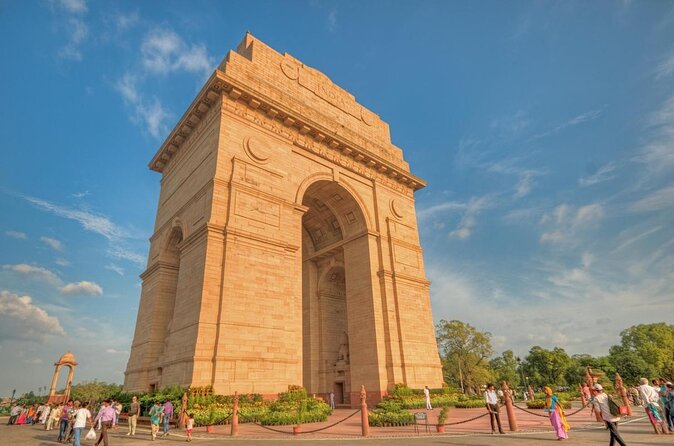
- Big Delhi hits like Qutb Minar, Lotus Temple, India Gate, and the formal government buildings
- Agra plus Fort and Baby Taj style stop at Itmad-ud-Daula
- Jaipur variety from Hawa Mahal and City Palace to Jantar Mantar and Panna Meena ka Kund
- One group only with a driver-guided rhythm that keeps the day efficient
Why this Golden Triangle works when you have limited time
Golden Triangle tours can go two ways: either you get a solid overview, or you feel like you’re sprinting through checkpoints. This one is built around the second idea, efficient but not chaotic.
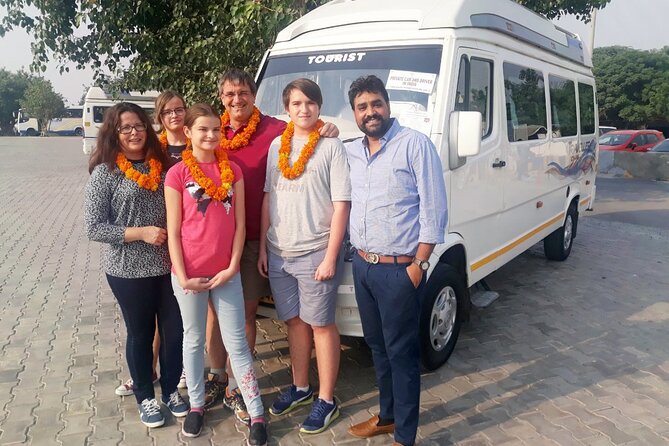
You get a private car and driver that scales with your group size (sedan for smaller groups, SUV or minivan for bigger ones). That matters on these routes because traffic, waiting, and last-minute schedule shifts can turn a “short” day into a long one. With a private setup, your guide can keep the pace realistic and adjust your order if timing gets tight.
You also get the kind of human help that makes first-time India feel easier. An English-speaking guide accompanies you through the city sightseeing, and the guide helps with entrance fees so you’re not hunting tickets or queuing.
You can also read our reviews of more private tours in New Delhi



Price and value, plus what you must budget separately
The listed price is $300 for the 4-day private experience. What you get for that price is mostly the “in-between” value that most travelers end up paying for anyway, private transport, trained guide time, and local logistics.
From the inclusions, you can expect:
- Private transportation with an air-conditioned vehicle
- Hotel or airport pickup and drop-off
- State GST and hotel taxes (when hotels are included)
- Bottled mineral water and soft drinks during journeys
- All city sightseeing places with a private local guide
- Battery-powered bus to and from the Taj Mahal parking area to the monument itself
On the cost side, plan for monument fees. Entrance fees are listed as $60 per person, and Qutb Minar is also listed at $60 per person. That looks like a clear budget item you cannot ignore, even if your guide handles ticket purchase during the day.
Also, the package description says breakfasts and dinners are included, while the inclusions list specifically calls out daily hotel breakfast. In practice, you should confirm dinner coverage based on your booking option, because the total value depends on whether dinners are truly part of your chosen hotel package.
Day 1 in Delhi: Qutb Minar, Lotus Temple, India Gate, and the government core
Delhi day is a smart mix of old, spiritual, and political architecture. It starts in the Qutb complex, built around Qutb Minar (also called Qutub Minar or Qutab Minar). This is the historic heart of the Qutb area, tied to Delhi’s oldest fortified city, Lal Kot, associated with the Tomar Rajputs. If you like seeing how layers of power show up in stone, this is your anchor stop. Expect about 1 hour for the Qutb Minar area, and plan entrance fees separately.
Next is the Lotus Temple, famous for its lotus-flower design and its modern start. It was inaugurated in 1986, so it gives you contrast against the medieval stonework around Qutb Minar. Give it around 30 minutes. Even if you do not follow any particular faith, you’ll appreciate how the building’s symmetry and calm design creates a pause in an otherwise fast-moving city day.
Then you move to the more formal, symbolic landmarks of central Delhi:
- India Gate (about 30 minutes). Construction completion is listed as 1931, and it’s tied to sacrifice and dedication of Indian soldiers.
- Parliament House (about 5 minutes). It’s described as a circular colonnaded building with ministerial offices, committee rooms, and an excellent library.
- Rashtrapati Bhavan (about 5 minutes). Home to the President, designed by Sir Edwin Lutyens and Herbert Baker, and listed as sitting on a large campus area.
After this city sweep, you get a lunch break at a local restaurant, then it’s on to Agra with about a 3-hour drive via Yamuna Expressway to your five-star hotel.
Practical note: Delhi can feel big and spread out. What makes this day work is that you’re not trying to win the city by yourself. You’re moving from one “anchor” landmark to the next with a guide explaining what each one represents.
Agra Day 2: Taj Mahal planning, Agra Fort, and Itmad-ud-Daula
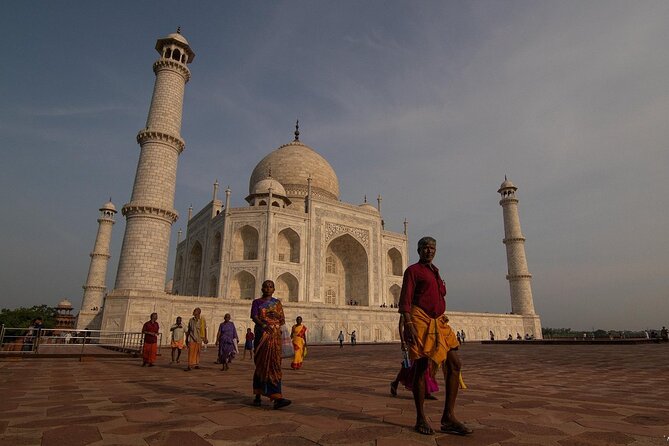
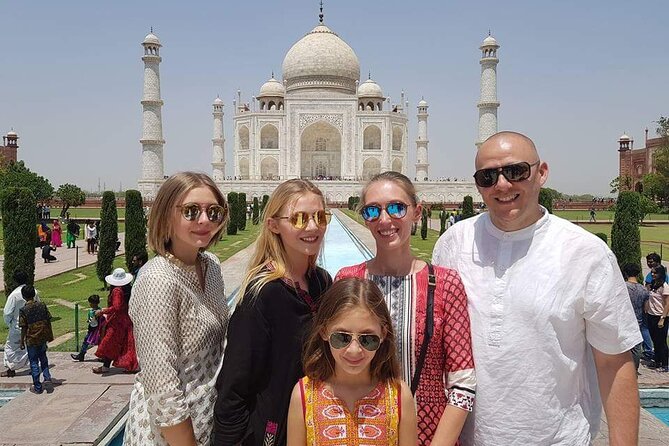
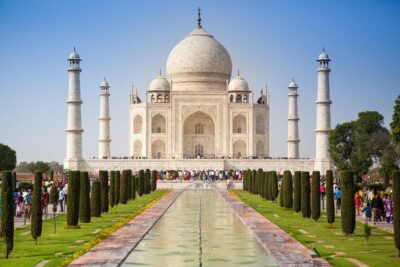
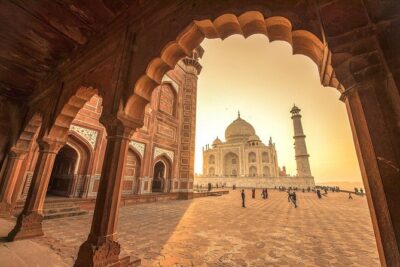
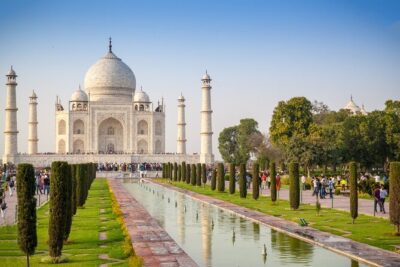
Agra is where the Golden Triangle earns its reputation, and this plan targets the Taj Mahal with real priority. The Taj Mahal stop is scheduled for about 2 hours, and the tour description highlights seeing it at sunrise. That usually means an early start, so be ready for a slower-moving morning that wakes up fast once you’re in the monument area.
One big inclusion that keeps the Taj Mahal experience smooth is the battery-powered bus between the parking area and the monument itself. That cuts down walking time, which matters if you’re visiting in heat or with uneven ground near entrances.
After the Taj Mahal, you tour:
- Agra Fort (about 1 hour). It’s described as built for Mughal Emperor Akbar between 1565 and 1573, and it ties into both Mughal history and earlier Rajput control before Mughals took over.
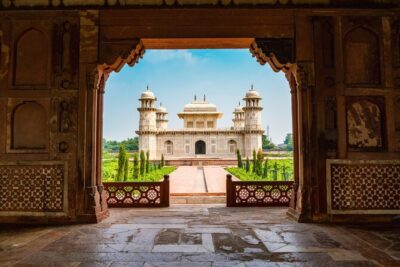
- Itmad-ud-Daula (about 30 minutes), often described as the Baby Taj or a “jewel box” mausoleum.
These two add up to more than filler. Taj Mahal gives you the emotional peak, while Agra Fort and Itmad-ud-Daula help you see the Mughal world’s scale and craftsmanship from different angles. If Taj is the headline, these are the supporting features that make the story stick.
Then you get lunch at a local restaurant, and you start the longer drive to Jaipur, about 4 to 5 hours via NH-21. En route, there’s a stop at Fatehpur Sikri, described as a small city west of Agra. In a Golden Triangle plan, enroute stops are often either a quick photo moment or a real break. Here, it’s meant to break the travel day while still giving you a historical focus before you reach Rajasthan.
Fatehpur Sikri en route: a history pause that breaks up the road

Fatehpur Sikri is scheduled as a stop while you transition from Agra to Jaipur. Even without spending a full day there, you get a chance to change scenery after the Mughal sites in Agra.
Because it’s described as a small city west of Agra, think of it as a structured breather stop, not a marathon. You’ll appreciate this if you prefer travel days to feel like travel plus something worthwhile, rather than just time in the car.



Day 3 in Jaipur: Hawa Mahal, City Palace, Jantar Mantar, Jal Mahal, Panna Meena ka Kund, and Amer Fort
Jaipur day is packed with variety, and that’s its strength. You start with the most recognizable symbol in the city: Hawa Mahal, the Palace of Wind.
- Hawa Mahal (about 30 minutes). Built in 1799 by Maharaja Sawai Pratap Singh, made with pink sandstone, and known for the five-storey facade with small latticed windows called jharokhas. Even if you only have half an hour, it’s the kind of structure you can’t help but notice from many angles.
Then you shift indoors, to royal power and design:
- City Palace of Jaipur (about 2 hours). This is where the Maharaja reigned, and the complex includes Chandra Mahal and Mubarak Mahal, plus other buildings. If you like seeing how a palace complex is planned like a mini-world, this is your main block.
After the palace, you go to a more unusual stop:
- Jantar Mantar (about 30 minutes). The tour description explains it as instruments for measuring the harmony of the heavens, and that it consists of 13 architectural astronomy instruments. It’s the kind of site where you’ll feel smarter just by looking, even if you do not do much science reading.
Next comes water and picture-perfect calm:
- Jal Mahal (about 30 minutes). It’s a palace in the middle of Man Sagar Lake, originally constructed in 1699, with later renovations and enlargement in the 18th century. The key here is that you’re stopping to see the composition of the palace and lake together, not just one building.
Then the day gets more local and architectural again:
- Panna Meena ka Kund (about 30 minutes). This is a square-design well, a baori or baoli, with eight levels of diamond-shaped steps descending to a deep green pool of water. It’s one of those Jaipur stops that rewards you for paying attention to shapes and geometry.
Finally, you head to the big fort focus:
- Amer Fort (about 2 hours). Your guide leads a tour of the fort, palaces, squares, and monuments, with various ramps and series of gates. The plan also notes Maota Lake in front of the monument area.
This sequence works well because it moves from iconic facade (Hawa Mahal), to royal architecture (City Palace), to astronomy (Jantar Mantar), to water setting (Jal Mahal), to patterned steps and wells (Panna Meena ka Kund), and ends with a fort that ties the whole story together.
Day 4: back to Delhi or drop-off at Jaipur airport
After breakfast, you start your return trip to Delhi. The drive is described as about five hours, and you can either be dropped back in Delhi or dropped off at Jaipur airport. That flexibility is useful if you booked flights later the same day.
Getting smooth service from pickup to monument entry
This tour succeeds or fails on one thing more than people expect: day-to-day friction. Private car tours can be great if the driver shows up calm, communicative, and consistent, and if your guide knows how to manage the crowds.
In the feedback you’ll see names like Rajendera Dewan (Mr Raju) and Raj as key contacts, with drivers such as Sandip and Aman mentioned alongside themes like punctuality and clean, comfortable cars. That kind of consistency matters because it reduces stress in the parts of the trip you cannot control, traffic, ticket lines, and timing between stops.
Two more details I think you’ll appreciate:
- Your guide helps you buy entrance fees on-site, so you are not stuck waiting in long queues to figure things out.
- The driver is described as available for extra needs such as a cab for dinner at a city restaurant or shopping, meaning you are not limited to only the scheduled blocks.
One caution from the service side is that not every day runs perfectly for every group. If you’re sensitive to tone or want a very specific interaction style from your driver, ask your operator what the standard communication approach is, and share any preferences up front.
Tips to enjoy the route and not just complete it
Here’s how I’d set you up for a smoother 4 days in Delhi, Agra, and Jaipur, based on the structure of the plan.
- Budget entrance fees early. You should assume monument tickets cost extra, and Qutb Minar has a separate listing.
- Pack for early mornings. With Taj Mahal planned around sunrise, you’ll want something warm for early air and comfortable shoes for walking.
- Carry small cash for quick stops. Even with a guide helping with entrance tickets, small purchases can happen around lunch breaks.
- Hydrate, even if you do not feel thirsty. The car includes bottled water during journeys, use it, and top up when you see a safe chance.
- Wear breathable clothing. You’ll be outside enough on these stops to feel it when the day heats up.
- Know what your “private” means. Only your group participates, which is a big advantage if you want control and flexibility, but it also means your pace is set by your guide and the shared schedule.
Who this tour is best for
This is a strong pick if:
- You are a first-time visitor to North India and want a straightforward overview.
- You have short time but still want a guided experience with private transport.
- You prefer comfort, pickup convenience, and clear structure over hopping between buses and trains.
It may be less ideal if:
- You want to spend lots of time lingering in one place, since this plan is intentionally efficient.
- You have mobility limits that make uneven walking difficult. The tour description notes a moderate physical fitness level is needed.
Should you book this 4-day private Golden Triangle?
If you want a private Golden Triangle that actually helps you enjoy your time, this one is a solid option. The value comes from how the transport, guides, and key logistics are bundled, and the route includes the classics plus architecture and craft stops that go beyond only big-name landmarks.
Before you book, do two quick checks:
- Confirm what’s included for breakfasts and dinners in your chosen hotel option.
- Confirm the exact monument fee total you should expect to pay in cash or card, especially with the Qutb Minar fee listed separately.
If you like structure, comfort, and clear guiding through the major sights of Delhi, Agra, and Jaipur, this tour deserves a serious look.
FAQ
How long is the 4-day Golden Triangle tour?
It lasts about 4 days, with city sightseeing across Delhi, Agra, and Jaipur and a return trip to Delhi (or drop-off at Jaipur airport) on day 4.
What does the tour cost?
The listed price is $300.
Is this a private tour?
Yes. It is a private experience, and only your group participates.
Do you get pickup and drop-off?
Yes. Pickup is offered from the airport, railway station, hotel, or other pickup location in Delhi, Noida, and Gurugram. You also get hotel or airport drop-off.
Are hotel nights included?
Hotel nights are included if you choose the option that includes hotels. The inclusions mention 3 nights accommodation.
Are entrance fees included?
No. Entrance fees for monuments are listed as not included, with monument entrance fees shown as $60 per person, and Qutb Minar also listed as $60 per person.
Will there be a guide?
Yes. You get an English-speaking guide, and private local guides are included for the city sightseeing.
How is the Taj Mahal visit handled?
A battery-powered bus is included to take you to and from the Taj Mahal parking lot to the monument area.
Can I cancel and get a refund?
Yes, free cancellation is available. You can cancel up to 24 hours in advance for a full refund.
More Private Tours in New Delhi



More Tours in New Delhi



More Tour Reviews in New Delhi
Not for you? Here's more nearby things to do in New Delhi we have reviewed








More Delhi City Tours to consider.
 ★ 5.0Old & New Delhi City Tour – Half or Full Day Options AvailableTickets from $384,811 traveller reviews
 ★ 5.0Same Day Taj Mahal, Agra Fort & Baby Taj Tour from Delhi by CarTickets from $624,304 traveller reviews
 ★ 5.0Taj Mahal Day Tour from Delhi by Superfast Train – TOP RATED TOURTickets from $1004,166 traveller reviews
 ★ 4.9Old and New Delhi Private Full or Half-Day TourTickets from $23,776 traveller reviews
 ★ 5.0Full Day Taj Mahal, Agra Fort & Baby Taj Tour from Delhi by CarTickets from $623,647 traveller reviews
 ★ 4.9From Delhi: Taj Mahal & Agra Private Day Trip with TransfersTickets from $43,181 traveller reviews
 ★ 5.0Taj Mahal Tour from Delhi by Express Train (Viator Award Winner)Tickets from $752,849 traveller reviews
 ★ 5.0All Inclusive Private Taj Mahal Luxury Tour from Delhi by CarTickets from $622,564 traveller reviews
More useful Delhi routes