

Review · DELHI CITY TOURS
New Delhi: Red Fort Entry Ticket with Optional Add-Ons
History hits you hard at the Red Fort. This guided visit pairs hassle-free entry at Lahori Gate with a live guide who turns Mughal architecture into an easy story, and you can extend the day with optional Old Delhi or Mughal-area add-ons. I love how the route focuses on the fort’s power points, from the entrance to the audience halls. One heads-up: Delhi security can affect opening days around Republic Day and Independence Day, so your dates matter.
My favorite part is the inside details, especially how the tour connects the grand court spaces to the artifacts in the fort’s museums, including objects tied to the Mughal era and the 1857 rebellion. When the fort’s history is explained alongside the light-and-sound presentation, the place stops feeling like a photo background and starts feeling like a real operating capital.
Key highlights you will actually feel

- Lahori Gate start makes it fast to orient yourself in the fort’s layout
- Naubat Khana to Diwan-i-Aam to Diwan-i-Khas gives you the full court story, public and private
- Lahore Gate photo moment is one of the fort’s most iconic views for a reason
- Museums with Mughal-era artifacts and 1857 references help you understand what you are seeing
- Optional add-ons let you pair the fort with Jama Masjid and Chandni Chowk, or with Humayun’s Tomb, Lotus Temple, and Qutub Minar
- Private-group pacing with live English and Hindi guiding, so you can ask questions without feeling rushed
Why the Red Fort experience works, even if you hate lectures

The Red Fort is not just a big wall and a red backdrop. It is a whole political world, laid out in gates, halls, and ceremonial spaces that make it clear how rulers displayed authority. Even if you only have a short window, a guided route helps you see the logic. You walk in the order that matches how power was staged.
What I like about this experience is the balance. You get the must-see architecture, but the guide also gives the human context, including how the Mughal Empire used spaces for performances, public court audiences, and private meetings. That turns the site from history-on-paper into architecture with a job to do.
The other big plus is practical. You are not left to interpret everything alone. A lot of Delhi monuments can feel like you are reading signs while dodging crowds. Here, you have a live guide, and you start at Lahori Gate, which cuts your confusion time.
More New Delhi tours and experiences for the shortlist



Meeting at Lahori Gate, and why your arrival time matters
The meeting point is at Lahori Gate, the main entrance into the fort. Your guide contacts you on WhatsApp before you start, which is useful because Old Delhi can be chaos-on-demand. In one case from past groups, the guide had to help people navigate to the correct entrance after maps looked confusing and blocked areas appeared. That is a good reminder to stay flexible around gate access.
Timing is also smart to think about. The overall activity runs about 1.5 to 2.5 hours, and the fort visit itself typically takes around 1 hour, depending on how long you spend inside spaces and how many photo stops you make. If you show up late, you might miss the calm moments in the halls where you can actually hear the explanation.
Also plan for walking on uneven surfaces inside the fort. Comfortable shoes are not a suggestion here, they are your sanity plan.
Entering the fort: Lahore Gate and Naubat Khana

Once you are through Lahori Gate, the fort opens into a rhythm of spaces that feels ceremonial. The Lahore Gate itself is one of the most iconic elements of the fort, and this tour uses it as a way to orient you quickly. You are not just taking a photo, you are learning what this entrance represents and how it connects to the areas you will visit next.
From there, you head toward Naubat Khana, often described as the Drum House. The key point is what it used to do. Royal musicians performed here, and the structure is tied to the idea of sound and signal. Standing near a space like this, it is easier to understand why Mughal architecture was designed for spectacle, not just for looks.
If you like details, Naubat Khana is one of those stops where a guide’s explanation makes a difference. Without context, it can look like another building in a large complex. With context, it becomes a cue in the story of how the court worked.
Diwan-i-Aam: the public court space that makes history feel real

Next comes Diwan-i-Aam, the Hall of Public Audiences. This is the big open space where the emperor would hold court and address people. The value here is visual. You get to stand in a setting that was built to handle crowds, protocol, and public messaging.
This is also where you should slow down for a minute. Take in the scale and the open layout. Then listen for the explanation of how the emperor’s position would have functioned in real life, not just in paintings. That is what turns this into more than a checklist stop.
Possible drawback: it can get hot, and it can feel busy depending on timing. Bring water and take short breaks. If you plan to shoot lots of photos, wear sunscreen and keep your head covered.
Diwan-i-Khas: the private audiences, refined and controlled
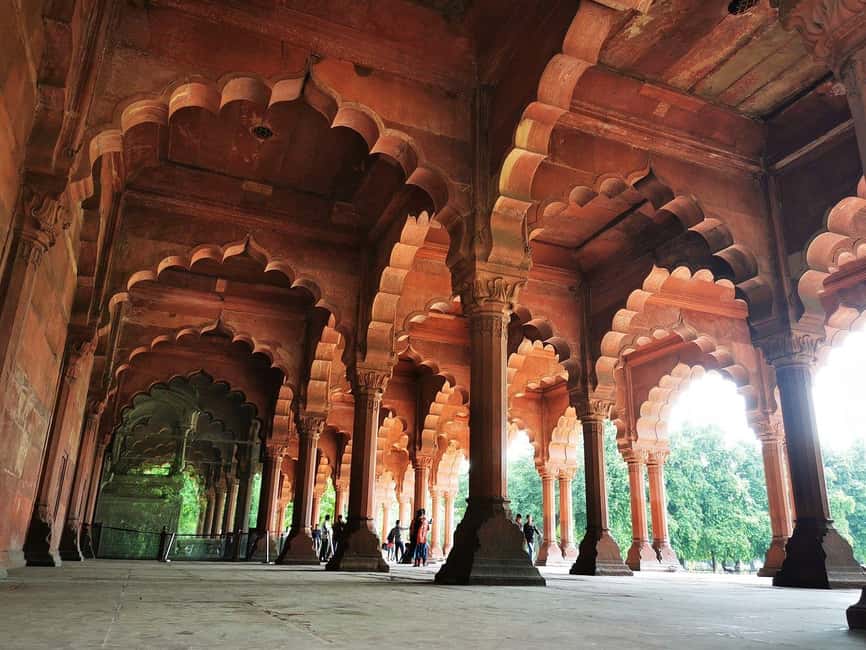
After the public hall, the tour shifts to Diwan-i-Khas, the Hall of Private Audiences. This chamber is described as beautifully adorned, and it is where the experience becomes more intimate. In practical terms, it is the contrast stop. Public order, then private power.
The guide’s job here is to help you see the difference in function. The Diwan-i-Aam explains the court in front of people. The Diwan-i-Khas shows the court working behind the scenes with officials and dignitaries.
If you like architecture, this is a satisfying pairing. You are moving from a broad open space into a more controlled environment. Your brain naturally notices the change, and the guide helps you connect that change to political reality.






Mumtaz Mahal and Zafar Mahal, plus museum time that actually helps
The tour also includes Mumtaz Mahal and Zafar Mahal. These are presented as key attractions that reflect a blend of Mughal and later architectural styles. Even without extra background, the tour framing helps you notice that the fort is not one single moment. It is a living complex that changed over time.
Then comes the smart part: the fort’s museums. The museums display artifacts connected to the Mughal era and references tied to the 1857 rebellion. This is valuable because the Red Fort is famous for its Mughal grandeur, but it also has a later layer that many people miss if they only focus on the visuals.
Here is how to use museum time well. Do not try to read everything like you are studying for an exam. Look for the themes your guide points out, then connect those themes back to the spaces you already saw. That back-and-forth is what makes the museum feel useful, not just time-consuming.
The light-and-sound story: what it adds, and how to enjoy it
One of the highlights is the light-and-sound show that frames the history of the fort and the Mughal Empire. If you care about narrative, this is a bonus because it stitches together what you learned in the halls.
How to enjoy it: stay present during the explanation moments, but do not stress about perfect timing. If your tour schedule feels rushed, prioritize the architecture stops first. The best outcome is leaving the fort knowing what you just saw, not forcing yourself to consume every presentation detail.
Optional add-on route 1: Red Fort, Jama Masjid, and Chandni Chowk

If you pick the Old Delhi pairing, you will add Jama Masjid and then time around Chandni Chowk. The route typically includes a ride segment by pedicab or rickshaw, which helps you cover distance without turning the day into a marathon.
Jama Masjid is a major anchor because it gives you a different kind of grandeur than the fort. You get a guided visit and time to sightseeing and walking. The big courtyard scale and intricate design are what you should focus on. This stop is especially good if you want Delhi’s religious architecture to balance the Mughal court story from the Red Fort.
Chandni Chowk brings you back to street life. You get a shorter window for shopping and atmosphere, plus the chance to savor local street food. Practical note: the tour rules say food is not allowed during the activity, so treat street food as a casual option if your schedule allows it outside the guided portions.
Possible drawback here is attention span and crowds. This add-on option is more sensory and more crowded. If you want quieter time for photography or museum reading, you might prefer the fort-only option or the more spaced-out Mughal highlight route.
Optional add-on route 2: Red Fort plus Humayun’s Tomb, Lotus Temple, and Qutub Minar

The second optional pathway adds a wide range of landmarks. After the Red Fort, you can visit Humayun’s Tomb, known for its garden-tomb style and for being an architectural inspiration for later Mughal work. Then the route includes the Lotus Temple, famous for its lotus-shaped design and calm atmosphere that welcomes visitors of all faiths. Finally, you close with Qutub Minar, described as the world’s tallest brick minaret, surrounded by ruins tied to early Delhi sultanate history.
Why this combination is smart: it gives you three different lenses on Delhi. Mughal royal design, spiritual architecture, then early sultanate ruins. If you like seeing how styles evolve across time, this is a satisfying day plan.
Possible drawback: you will cover more ground. Even if the tour remains organized, your feet will do more work and your brain will switch gears more often. Bring your water, and keep expectations realistic about how much you can take in without feeling like you are rushing.
Price and value: what $9 buys you, and what you should compare
The price listed is $9 per person, and for that you get a guided experience with hassle-free entry, and skip-the-ticket-line is part of the concept. If your selected option includes it, you also get the entry ticket. You are basically paying for time saved and context gained, not just access to a building.
Here is the value math that matters. If you have any interest in understanding what you are looking at, a guide turns the Red Fort route into a guided narrative. The fort has multiple major structures, like the Naubat Khana, Diwan-i-Aam, Diwan-i-Khas, and the museum layer. Without help, you can still enjoy it, but you will spend more time guessing.
This is also a private group setup, so you should feel less friction. In past experiences with guides like Rambabu, Anas, Gyanendra, Adel, and Priyam, the standout pattern has been friendly, professional guidance and a willingness to adapt when plans go sideways, including staying longer when arrival is delayed. That kind of service matters, especially in a monument complex where small navigational issues can cost you real time.
Practical tips that keep the day smooth inside Old Delhi
A few rules and packing choices are clear, and they help you enjoy the site more:
Bring:
- Comfortable shoes
- Hat
- Camera
- Sunscreen
- Water
Not allowed:
- Pets
- Smoking
- Drones
- Plastic bags
- Food
- Alcohol and drugs
- Firework
Also, keep your dates in mind. The Red Fort is generally closed on Republic Day (January 26) for security reasons, and it may close from January 20 to January 30. Around Independence Day (August 15), it can also close for a few days before and after due to security arrangements. If your trip window falls in those periods, confirm ahead so you do not show up for a photo you cannot take.
Finally, English and Hindi live guiding is available. If you know a little Hindi, it helps, but you do not need it. The whole point is you can ask questions and get answers during the walk.
Who should book this Red Fort plan
This tour makes the most sense if you want:
- A focused Red Fort experience with major stops like Diwan-i-Aam and Diwan-i-Khas
- A guide-driven way to understand how the fort layout connects to Mughal power
- Optional add-ons that match your interests, Old Delhi life, or a larger Mughal-to-early-Delhi route
- A private group pace, so you can move when you want and ask as many questions as you like
It is a good fit for first-time Delhi visitors, and it also works if you are returning and want a sharper route through the most meaningful sights.
Should you book this Red Fort entry and add-on tour?
Yes, if you want the Red Fort to make sense. The guide-led route turns iconic buildings like Lahori Gate, Diwan-i-Aam, and Diwan-i-Khas into a coherent story, and the museum stop adds the layer that many people miss. The add-on options also make it easy to build a half-day or longer day without scrambling for connections.
Book it especially if you are traveling with limited time and you dislike wasting hours figuring out where to go next. Just keep your travel dates away from the known closure windows around late January and Independence Day, and you will have a much smoother experience.
More Tickets in New Delhi



More Tour Reviews in New Delhi



Not for you? Here's more nearby things to do in New Delhi we have reviewed











More Delhi City Tours to consider.
 ★ 5.0Old & New Delhi City Tour – Half or Full Day Options AvailableTickets from $384,811 traveller reviews
 ★ 5.0Same Day Taj Mahal, Agra Fort & Baby Taj Tour from Delhi by CarTickets from $624,304 traveller reviews
 ★ 5.0Taj Mahal Day Tour from Delhi by Superfast Train – TOP RATED TOURTickets from $1004,166 traveller reviews
 ★ 4.9Old and New Delhi Private Full or Half-Day TourTickets from $23,776 traveller reviews
 ★ 5.0Full Day Taj Mahal, Agra Fort & Baby Taj Tour from Delhi by CarTickets from $623,647 traveller reviews
 ★ 4.9From Delhi: Taj Mahal & Agra Private Day Trip with TransfersTickets from $43,181 traveller reviews
 ★ 5.0Taj Mahal Tour from Delhi by Express Train (Viator Award Winner)Tickets from $752,849 traveller reviews
 ★ 5.0All Inclusive Private Taj Mahal Luxury Tour from Delhi by CarTickets from $622,564 traveller reviews
More useful Delhi routes