
Review · DELHI CITY TOURS
Private City Tour to Old and New Delhi
Delhi packs a lot into a small time window. This private Old and New Delhi route links together major monuments across eras, with an air-conditioned car, bottled water, and a smooth pickup around Connaught Place. I also like the human touch from Ashok Tour, where the host and drivers have a reputation for being friendly, polite, and easy to work with, including English-speaking drivers.
You’ll need to plan for one catch: several big sites require paid entry, and Akshardham’s security rules ban bags, cameras, and electronic devices inside the complex. That can add a bit of friction if you show up overpacked.
Key highlights at a glance
- A tight, high-impact route that mixes the Sultanate era, Mughal power, and modern religious landmarks
- Private group of up to 5, so you can move at a pace that feels right for you
- Air-conditioned vehicle and bottled water included, a real win in Delhi heat and traffic
- Free stops built in, including Lotus Temple, India Gate, and Lodhi Garden
- Akshardham inside rules (no bags or electronics) make you travel lighter for the best experience
A Private Old and New Delhi Route, Built for First-Time Orientation
This tour works because it helps you build a mental map of Delhi fast. In one half day to full day, you see how the city layers power and faith: first with the soaring minaret of Qutub Minar, then Mughal-era monuments like Humayun’s Tomb and the Red Fort, then major religious sites you can compare side by side.
I like that it’s not a crowded bus experience. You’re in a small private group up to 5, with your own car. That matters in Delhi. Even when the destinations are impressive, the drive between them can eat time. Having a private vehicle and pickup from Connaught Place means you spend more of your day looking at monuments, not negotiating logistics.
You’ll also get practical comfort from the included features: an air-conditioned vehicle and bottled water. It sounds small until you’re standing in sun and wind outside a monument, trying to focus while traffic and temperatures keep moving.
You can also read our reviews of more city tours in New Delhi


Where the tour starts and ends
The tour starts at Connaught Place in New Delhi and ends back at the meeting point. That’s ideal if you want to avoid long end-of-day transfers.
Price and what it really buys you
The price is $65.00 per group (up to 5 people). For a private car and driver, that can be good value, especially if you have a small group. The real question is how the not-included costs affect the total.
Here’s what’s covered and what’s not, based on the tour details:
- Included: air-conditioned vehicle and bottled water
- Not included: entrance fees listed as $50 for two persons
- Some stops are free (Lotus Temple, India Gate, Lodhi Garden)
So the way to think about value is this: you’re paying for convenience and a curated route, not for every ticket. If you’re traveling as a couple, the $50 estimate may be close to what you’ll pay for the major paid sites. If you’re traveling as a group of five, you’ll likely want to confirm how the $50 entrance-fee estimate scales for your exact headcount.
Also, keep your expectations realistic. This is a highlights route. You’ll get strong sight-seeing, but not a slow museum deep dive or long, flexible hang time at each checkpoint.
Qutub Minar: The Minaret that Sets the Tone for Delhi
Stop one is Qutub Minar, a UNESCO World Heritage Site. What I like about starting here is that it immediately gives you Delhi’s oldest “wow” landmark. The tower dates to the early 13th century. Built by Qutub-ud-din Aibak, it was completed by Iltutmish, then enhanced later by Firoz Shah Tughlaq and Sikandar Lodi.
From a design point of view, it’s Indo-Islamic Afghan architecture made visible. The monument rises 73 meters tall, with a wide base and a tighter top. If you’ve only seen photos, seeing the proportions in person is when it clicks. It’s not just tall, it’s also sharply structured.
You’ll also want to look for the Iron Pillar in the Qutub complex. The tour notes it as part of what you’ll see, so it’s worth a quick scan rather than rushing past everything in one glance.
A practical caution
Plan for a full “look and orient” stop. One hour can be enough if your goal is a solid photo set and clear understanding, but you may want more time if you love architectural details.
You can also read our reviews of more private tours in New Delhi






Humayun’s Tomb: Mughal Elegance Before the Taj Mahal
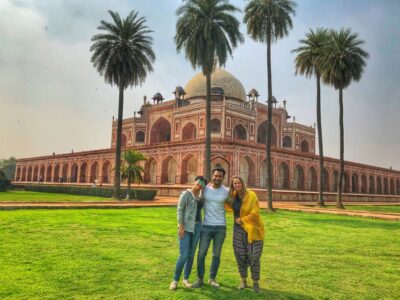
Next up is Humayun’s Tomb, built in the mid-16th century, commissioned by Empress Bega Begum and completed in 1572. This stop is especially valuable because it sits at the crossroads between Persian-influenced design and Indian craftsmanship.
The tour describes Humayun’s Tomb as a masterpiece of Mughal architecture, often seen as a precursor to the Taj Mahal. The design was created by Persian architect Mirak Mirza Ghiyas, with Persian and Indian elements woven together.
If Qutub Minar is about dramatic height and early imperial style, Humayun’s Tomb feels more like controlled beauty. The gardens and layout matter here. Even if you don’t memorize every detail, you’ll feel the symmetry and calm planning, which makes this stop a nice contrast.
Timing tip
The schedule gives about an hour. Use that time to slow down once. Stand, look across the main view, and then start circling. That one shift helps you actually see why people treat this site as a turning point.
Lotus Temple: A Worship Space Built for Silence (and Free Entry)
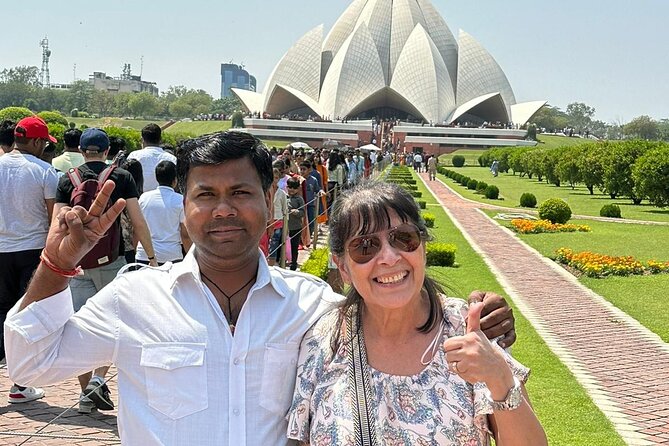
Then you jump into the kind of calm you don’t always expect in Delhi. The Lotus Temple is a Bahá’í House of Worship and serves as the Mother Temple of the Indian subcontinent.
The big idea I appreciate here is openness. The tour notes that Bahá’í Houses of Worship are for all people, regardless of religion. The Lotus Temple is designed for meditation and prayer, and it keeps a quiet atmosphere inside. Visitors are welcome to enter, but the setting is meant for stillness.
The architecture is instantly recognizable: a white marble lotus flower form designed by Iranian architect Fariborz Sahba and completed in 1986. The landscaped gardens around it also help. You’re not just staring at a building, you’re stepping into a planned space.
A practical caution
This is a free admission stop, but don’t treat it like a quick photo pit. The best use of your 30 minutes is quiet entry and a slow look, not speed-walking.
India Gate: World War I Memory in Red and Yellow Sandstone
After the calm, you move to a monument that teaches you something different about Delhi: the city’s layered colonial-era history.
India Gate was originally called the All India War Memorial. The foundation stone was laid in 1921, and it was completed in 1931. Its architecture is inspired by the Arc de Triomphe in Paris, built in red and yellow sandstone and rising 42 meters.
This stop also has the kind of detail that turns a landmark into a story. The archway is inscribed with names of more than 13,516 soldiers killed in the Northwestern Frontier War of 1919. At the base, the tour notes the Amar Jawan Jyoti, an eternal flame.
You get about 30 minutes here, and that’s enough if your goal is to understand the memorial concept and take in the scale.
How to get the most from 30 minutes
Stand back first, then come in closer. The first view gives you the monument’s “power pose.” The second helps you appreciate how the inscriptions and flame anchor the whole site.
Red Fort: Mughal Power, Plus Two Very Different Audience Halls
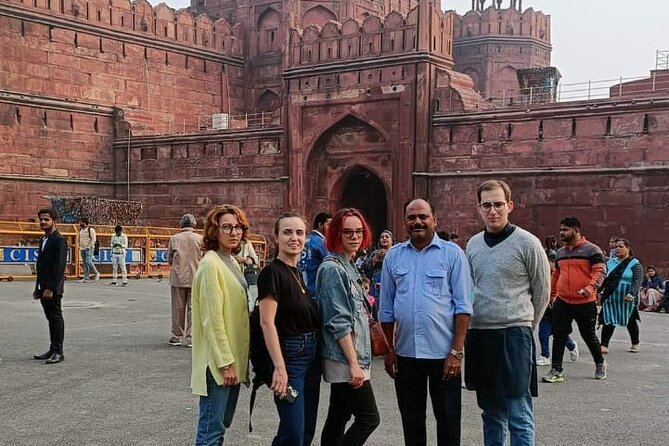
Next is Red Fort, one of the main Mughal landmarks of Delhi. The fort was built by Shah Jahan starting in 1638 and completed in 1648. It served as the main residence for Mughal emperors for nearly 200 years.
The architecture is Mughal style with red sandstone walls and intricate white marble inlays. If you’ve ever wondered how “imperial” looks in built form, Red Fort answers that fast.
Two internal areas highlighted on the tour are the Diwan-i-Aam and Diwan-i-Khas:
- Diwan-i-Aam, the Hall of Public Audience
- Diwan-i-Khas, the Hall of Private Audience
That contrast matters. You’re not just seeing a fortress. You’re seeing how rulers imagined access: public visibility versus private authority.
What can slow you down
Red Fort has paid entry (not included). If your timing feels tight, give yourself permission to prioritize one or two key interior areas instead of trying to “do everything.”
Jama Masjid: A Major Mughal Mosque and Its Grand Gateway
From the fort you shift to worship architecture: Jama Masjid. It was commissioned by Shah Jahan, construction began in 1650, and it took six years, finishing in 1656. The tour credits Ustad Khalil as the architect.
The building uses red sandstone and white marble in a classic Mughal combination. The main entrance is through the Buland Darwaza, a grand gateway facing east, described as a masterpiece.
This stop is quick, about 30 minutes, so treat it as an exterior and gateway-focused visit unless your guide suggests a deeper interior pause.
Best way to spend your time here
Look at the gateway details first. Then take a moment to orient yourself within the larger mosque space. When you understand the layout even briefly, the scale hits harder.
Akshardham: The Incredibly Detailed Temple Complex, With Strict Security
Now for the modern-feeling highlight: Swaminarayan Akshardham. The tour notes it was inaugurated on November 6, 2005 and built by BAPS, inspired by spiritual leader Pramukh Swami Maharaj.
The centerpiece is the Akshardham Mandir, dedicated to Bhagwan Swaminarayan. The tour also points out that the mandir is surrounded by 234 intricately carved pillars, 9 domes, and over 20,000 statues.
This is where you’ll feel the difference between Delhi’s older monuments and a newer, devotional design approach. If your eyes get tired, that’s normal. The detail density is high, so the trick is to pick a few areas and focus.
Important security rules you must plan around
The tour specifically states you cannot carry bags, cameras, or electronic devices inside the temple complex. There is a secure facility where you can leave your belongings.
That matters for your day. If you bring a bulky day bag or you’re planning to rely on your phone camera heavily, you’ll want to rethink what you carry. Keep only what you truly need for the outside and walking portions.
The time here is longer, 1 hour 30 minutes, which helps. If you treat it like a 20-minute stop, you’ll feel rushed. This one deserves a slower pace within the time you have.
Lodhi Garden: The Calm Reset Between Monument Stops
To finish, you get a breather: Lodhi Garden. It’s named after the Lodhi Dynasty, which ruled parts of northern India in the 15th and 16th centuries. The garden contains monuments from that period and gives you a green pause inside the city.
The tour says Lodhi Garden covers 90 acres and sits between Khan Market and Safdarjung’s Tomb. It’s a popular spot for locals and tourists who want space to walk, jog, or just relax.
This is a smart end cap because it stops the day from turning into a nonstop “stand, stare, move.” You can stretch your legs, step away from the monument crowd energy, and let the day’s sights settle.
Free entry stop
The tour lists admission as free here, and the visit is about 30 minutes. That’s ideal for a gentle reset before you head back.
Timing, Delhi Traffic, and How to Stay Comfortable
Delhi isn’t a city where you can ignore traffic. Even with a private car, your schedule can feel jumpy. So I recommend you treat the day as a sequence of priorities, not a racing clock.
Also pay attention to the listed operating window. The tour details show opening hours for Monday: 10:00 AM to 4:00 PM. If you book on another day, you’ll still want to align your expectations with the daytime sightseeing window.
If you’re deciding between the shorter and longer end of the tour duration, here’s the practical way to choose:
- Choose the shorter end if you want to see the highlights and keep your energy for evening plans.
- Choose the longer end if you like time for photos, calmer looks, and a bit more breathing room at the paid sites.
What I’d Pack (Based on What This Day Actually Requires)
You’re getting air-conditioning in the car and bottled water, so you don’t need to bring much for comfort. But you do need to match your packing to the sites.
Key items to consider:
- A small day bag, but remember Akshardham has bag and electronics restrictions inside
- A plan for paid entries at major monuments (the tour lists an entrance-fee estimate)
- Comfortable shoes for walking through tomb and fort areas
- Sun protection, since several stops are exposed and you’ll likely be outside for part of the visit
If you hate the idea of leaving stuff behind, ask before the day starts what they recommend bringing for Akshardham so you’re not scrambling when you arrive.
Who This Tour Fits Best
This is a strong pick if:
- You’re on a first visit and want major monuments across Old and New Delhi in one organized day
- You’re traveling with a small group of up to 5 and want private logistics
- You want air-conditioned transport and a clear sequence of stops
- You appreciate seeing how different eras of Delhi show up in architecture, from Qutub Minar to Mughal sites to Akshardham
It may not be the best fit if:
- You want a slow, market-focused Old Delhi food and street-walk experience
- You prefer long guided museum-style time at each site rather than quick, effective stops
Should You Book This Private City Tour?
I’d book it if you want a high-signal Delhi day: enough variety to understand the city, enough comfort to handle the pace, and enough free stops to balance the paid ones.
The main decision point is planning for costs and site rules. If you pack light and don’t mind paying entry for several major monuments, this route is a smart way to get your bearings fast. If you need lots of shopping time or you dislike any kind of security holdback, you may want a different style of tour.
If you book, I’d also do one simple thing: ask your driver how you should handle Akshardham’s no bags or electronics rule so you start that portion ready, not stressed.
FAQ
How much does the Private City Tour to Old and New Delhi cost?
It costs $65.00 per group, for up to 5 people.
How long is the tour?
The duration is approximately 4 to 8 hours.
Does the tour include pickup and where does it start?
Pickup is offered, and the tour starts at Connaught Place, New Delhi, Delhi 110001, India. It also ends back at the meeting point.
Is this a private tour?
Yes. It is a private tour/activity, with only your group participating.
Are entrance fees included?
Entrance fees are not included. The tour lists entrance fees as $50 for two persons.
Which stops are free?
Lotus Temple, India Gate, and Lodhi Garden are listed with admission ticket free.
What is included in the tour?
The tour includes an air-conditioned vehicle and bottled water.
What are the listed operating hours?
The provided operating hours show Monday from 10:00 AM to 4:00 PM.
Is free cancellation available?
Yes. You can cancel up to 24 hours in advance for a full refund.
More City Tours in New Delhi



More Tours in New Delhi




More Tour Reviews in New Delhi
Not for you? Here's more nearby things to do in New Delhi we have reviewed










More Delhi City Tours to consider.
 ★ 5.0Old & New Delhi City Tour – Half or Full Day Options AvailableTickets from $384,811 traveller reviews
 ★ 5.0Same Day Taj Mahal, Agra Fort & Baby Taj Tour from Delhi by CarTickets from $624,304 traveller reviews
 ★ 5.0Taj Mahal Day Tour from Delhi by Superfast Train – TOP RATED TOURTickets from $1004,166 traveller reviews
 ★ 4.9Old and New Delhi Private Full or Half-Day TourTickets from $23,776 traveller reviews
 ★ 5.0Full Day Taj Mahal, Agra Fort & Baby Taj Tour from Delhi by CarTickets from $623,647 traveller reviews
 ★ 4.9From Delhi: Taj Mahal & Agra Private Day Trip with TransfersTickets from $43,181 traveller reviews
 ★ 5.0Taj Mahal Tour from Delhi by Express Train (Viator Award Winner)Tickets from $752,849 traveller reviews
 ★ 5.0All Inclusive Private Taj Mahal Luxury Tour from Delhi by CarTickets from $622,564 traveller reviews
More useful Delhi routes