
Review · DELHI CITY TOURS
Old & New Delhi Full or Halfday Guided Tour with Street Food
Delhi hits you fast, in one day, especially with street food and a private guide mapping the city for you. I love the smooth, air-conditioned ride between New Delhi landmarks and Old Delhi lanes, and I like that the schedule strings together major sights without forcing you to figure out transport. The only catch is simple, this is a lot of walking and looking for a 4 to 8 hour day, so plan for crowds and comfortable shoes.
Your driver picks you up from your hotel or the airport area in Delhi and does the meet-and-greet. From there, you move past government buildings for photo stops, then settle into a guided route that mixes big monuments, spiritual stops, and market time.
One more plus: you get skip-the-line entry through a separate entrance, plus a guide available in multiple languages, including French, Spanish, and Arabic. If you’re traveling on a Monday, plan for the note that Lotus Temple and the Red Fort are closed, and the plan shifts to other stops like Raj Ghat and Jantar Mantar.
Key points to plan your day
- Private A/C car and live guide so you are not stuck haggling, guessing, or waiting.
- Photo-worthy New Delhi passes like India Gate, Parliament House, and Rashtrapati Bhavan.
- Old Delhi tuk tuk ride plus Jama Masjid, Chandni Chowk lanes, and spice market time.
- Street-food lunch window built in after Jama Masjid, timed for maximum local flavor.
- Optional choices like Raj Ghat and Qutub Minar, depending on your energy.
- Monday adjustments if you are there when Lotus Temple and the Red Fort are closed.
Private transport that actually helps in Delhi traffic
Delhi is not a city you casually “wing.” Distances add up fast, and traffic can turn a short day into a slow day. This tour solves the practical part with private A/C transport and a dedicated driver, so you can focus on the places instead of coordinating rides.
I also like the pacing logic: you are picked up, then moved in a route that clusters sights by area. New Delhi monuments first, Old Delhi later, with a clear end-of-day drop-off to where you want to go in Delhi. That order matters because the light and the energy of the neighborhoods are different, and you get a more coherent view of the city.
If you are sensitive to long days, this is still a packed itinerary. But because the car is private and your guide is local, the “in-between time” feels managed instead of wasted.
You can also read our reviews of more food & drink experiences in New Delhi



New Delhi photo stops: India Gate, Parliament, and Rashtrapati Bhavan
The New Delhi portion starts with classic big-city landmarks and quick photo moments, which is a smart way to get your bearings. Your guide explains what you are seeing as you pass key buildings, then stops for pictures of India Gate.
India Gate is one of those monuments where a short explanation makes a huge difference. Once you know what it represents, the photos stop being just postcards and start being context. From there, you drive past Parliament House and continue to Rashtrapati Bhavan, the President’s residence.
Rashtrapati Bhavan is often described in terms of scale, and this tour gives you specific facts to hold onto. It may refer to the main building with 340 rooms, and it took 17 years to complete. Even if you do not go inside every room, having those details gives you a better read on the architecture and why the complex looks the way it does.
A practical tip: New Delhi is a good place to decide how much you want to walk versus how much you want to photograph. This section is heavier on drive-by interpretation and photo stops, so it can work well even if you are not trying to get your steps in early.
Akshardham and Humayun’s Tomb: two very different spiritual styles
After the government-building photo stretch, the route moves into temple and heritage territory.
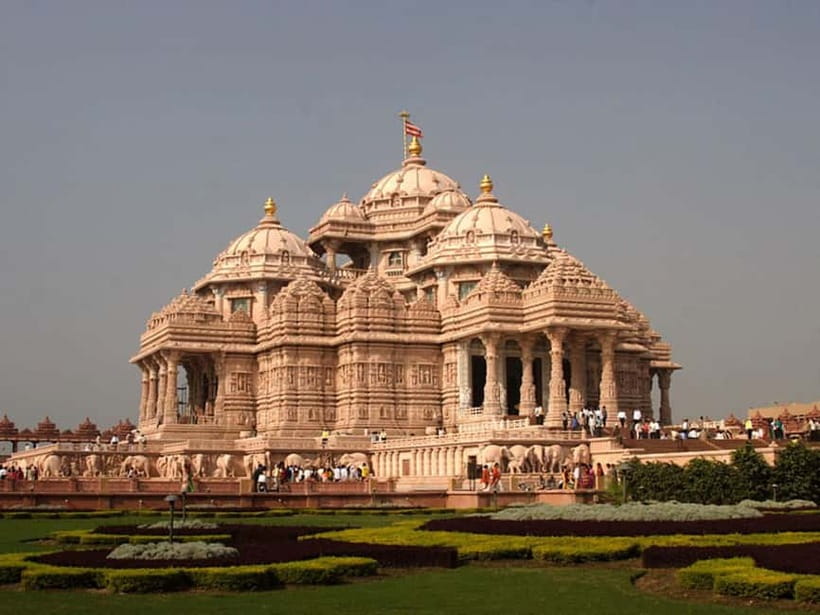
Swaminarayan Akshardham is presented as one of the biggest Hindu temples in the area. You’ll hear that it was constructed in 2005, but the design reads older than that, because of the architecture. That contrast is worth noticing. You are not just seeing a temple, you are seeing how modern construction can imitate older styles, and how that affects your impression when you arrive.
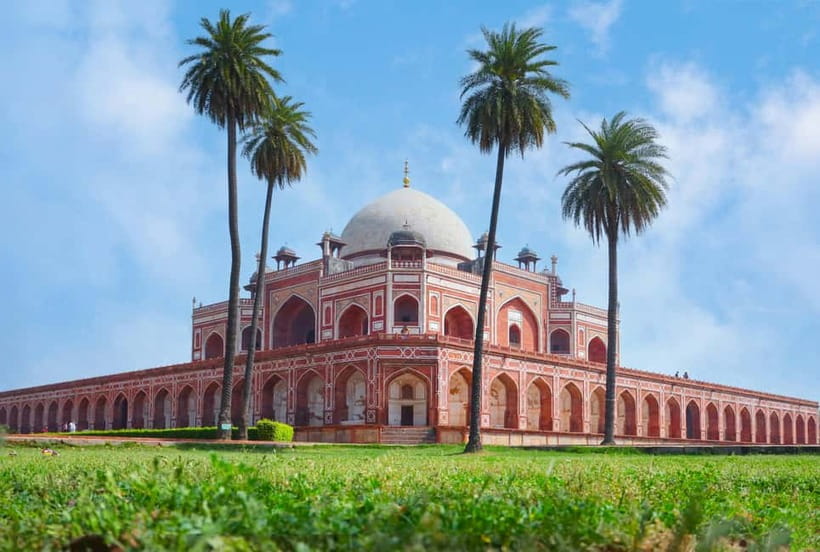
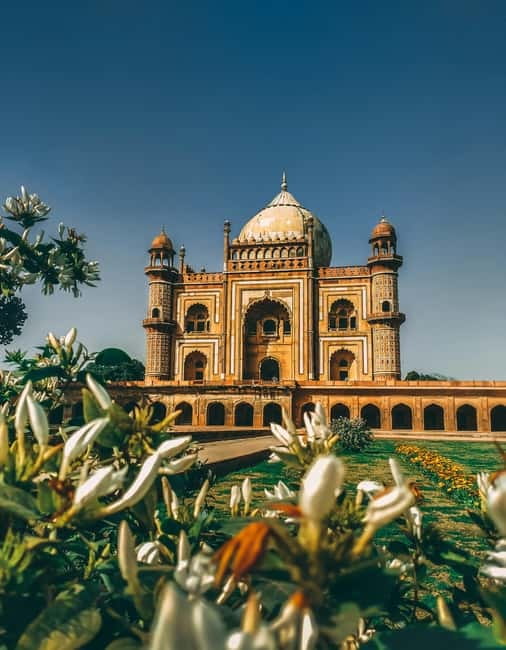
Then comes Humayun’s Tomb, a UNESCO World Heritage Site. It is described as the first garden tomb in India, and the tour frames it as a major landmark built by the wife of Humayun. Garden tombs can sound like a trivia line, but here it helps you understand the concept: the design blends monument and landscape in a way that makes the space feel deliberate, not just decorative.
If you are someone who likes stories more than checklists, you’ll likely enjoy this part. It gives you a “why this matters” layer for both the Hindu temple experience and the Mughal-era heritage site.
Raj Ghat, Lotus Temple, or Qutub Minar, you choose

This tour gives you options, and that flexibility is real value if your day has to match your mood or your flight time.
Raj Ghat is optional. It is a memorial dedicated to Mahatma Gandhi in Delhi. If you want a reflective pause in the middle of the more fast-paced sightseeing, this is the kind of stop that slows your pace in a good way.
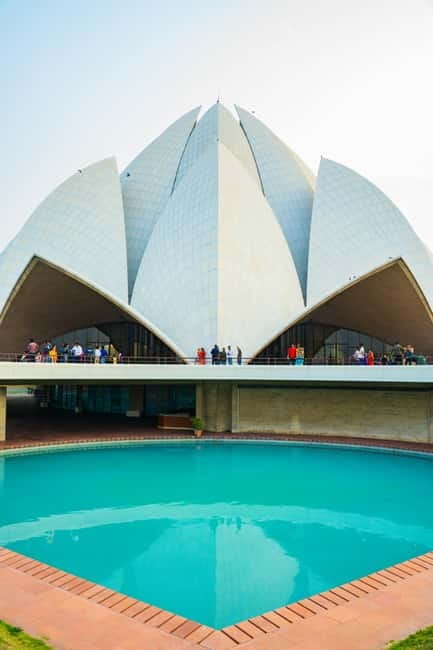
Lotus Temple is another optional choice, and the plan suggests Lotus Temple as the last stop in Delhi if you skip Qutub Minar. Lotus Temple is a Bahá’í House of Worship dedicated in December 1986, and it is known for its flower-like shape. The tour description frames it as a major attraction because the form is so instantly recognizable, even from a distance.
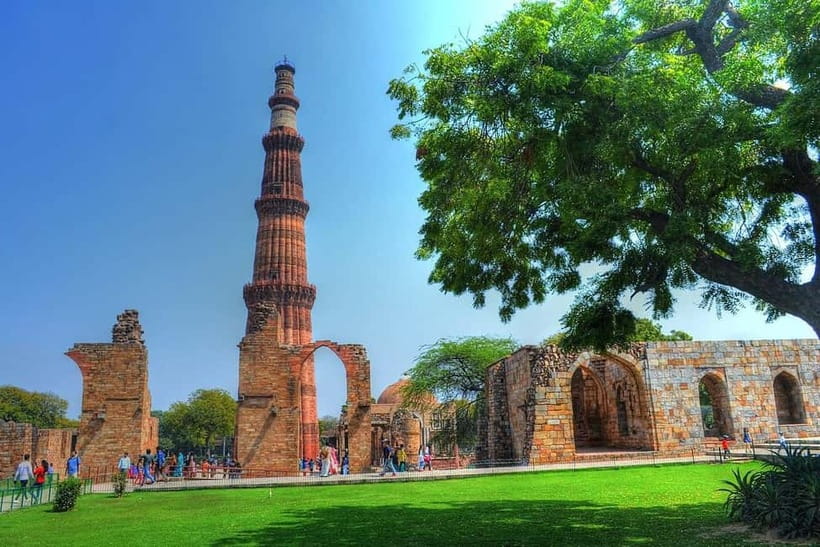
Qutub Minar is the other big option. It is described as the highest brick tower in India, built in 1192, and it is part of a UNESCO World Heritage Site. The guide will connect it to early Muslim rule in India, which helps you place the tower historically instead of treating it as just a tall structure.
One Monday note you should care about: Lotus Temple and the Red Fort are closed on Mondays. On that day, the tour indicates you can go to Raj Ghat and Jantar Mantar instead. If your travel dates land on a Monday, this is where your itinerary choice matters most.
Old Delhi by tuk tuk: Jama Masjid first, then lunch

When Old Delhi begins, the tour shifts gears. You go from major monument viewing to street-level life.
You’ll enjoy Old Delhi on a tuk tuk ride while your guide explains the important role this oldest part of Delhi plays for locals. That matters because Old Delhi is not just “sights,” it is daily routines, commerce, and community all in the same lanes. A guide helps you read what you see, like why markets cluster where they do and why certain areas feel busier at certain times.
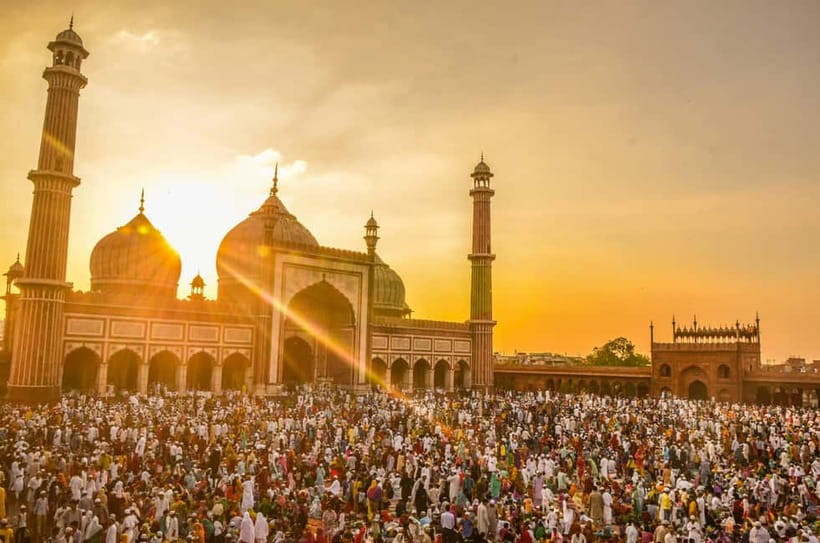
Your first major stop in Old Delhi is Jama Masjid, described as India’s largest mosque. The tour notes it was built by Mughal Emperor Shah Jahan between 1644 and 1656, and that it cost 1 million rupees. Those numbers can feel abstract until you’re standing near the scale and details. Then it clicks: this was an intentional statement, not a casual building project.
Right after Jama Masjid, you get a lunch window focused on tasting and eating the famous dishes of Delhi. The plan frames it as lunch after your visit, so it is built into the flow rather than tacked on as an afterthought. Do not expect this to feel like a sit-down restaurant tour. Expect street food style choices, and build your appetite accordingly.
If you are picky about food or have dietary needs, treat this lunch stop as the moment to ask your guide how to order safely and what is easiest to eat on the go. The tour data does not list specific dishes, so your best move is to tell your guide your comfort level.
More New Delhi tours and experiences for the shortlist





Khari Baoli spices and Chandni Chowk lanes: where to focus
After your lunch and Old Delhi mosque stop, you move into the market layer of the city.
Khari Baoli is the spice market. Your guide’s role here is useful, because you are not just walking past jars and stalls. You get facts and uses of spices, which turns the sensory overload into something you can actually remember. You’ll likely spot spices by color and shape first, but the explanation gives you the “what they do” side.
Then the itinerary heads into Chandni Chowk exploration. This is where Old Delhi’s lane system comes to life: narrow streets, shops selling everything from spices and sweets to jewelry and textiles. The key here is to manage your time and expectations. Market days can turn into shopping marathons if you let them.
A practical approach I’d recommend: treat Chandni Chowk like a photo and flavor walk first. If you want to buy something, great. If not, you still get a full experience by watching how people move, sampling what your guide suggests, and noticing what each shop specializes in.
There is also a Red Fort viewing angle here, though it is listed as a pass by stop. You’ll see the massive structure associated with Shah Jahan, built between 1639 and 1648, and framed as the main residence for Mughal emperors. Even if you do not enter, the perspective is worth it because it connects the street-level market energy to the political power that shaped the city.
Gurudwara Bangla Sahib: the kitchen that feeds thousands

Old Delhi ends with a spiritual stop that feels different from the mosque and temple experiences earlier in the day.
Gurudwara Bangla Sahib is described as a Sikh gurdwara and noted for having the largest kitchen in India. The tour states it prepares food for 10,000 people every day. That detail changes how you look at the place. You are not just seeing an ornate building, you are seeing a system built for community service at huge scale.
This is the kind of stop where your guide can help you understand the purpose behind the rituals and the flow of visitors. If you like “why people do what they do,” this part is a good payoff after the market intensity.
Finally, you wrap up with the driver dropping you at any desired location in Delhi. That end flexibility is helpful because Delhi plans can go sideways if you do not control the last leg. Here, you do.
Price, time, and what $11 really buys in Delhi

At about $11 per person, the headline price looks almost too good. The value comes from what is bundled into that low cost.
Included items listed for the experience include hotel pickup and drop off, private air-conditioned transport, a private live tour guide, entrance tickets, bottled mineral water, and all taxes and charges. It also includes a skip-the-line approach through a separate entrance.
So what does that mean for you? It means you are paying for time saved and friction avoided. In a place like Delhi, transportation plus guide time alone can eat a budget quickly. Add entry tickets for multiple major sites and the day gets more expensive if you do it on your own.
The duration range, 4 to 8 hours, is the other part of the value equation. Shorter days mean fewer sites or less time in each stop. Longer days mean more breathing room and better photo time. Either way, the private car and guide are what keep it from feeling like a group bus ride.
One realistic consideration: because it is a guided route with many stops, you are not buying a slow, relaxed day. You are buying an efficient day that still covers spiritual, historical, and street-level Delhi.
Who should book this tour, and who should skip it
This experience fits best if you want a guided sampler of Delhi that balances big monuments with real local neighborhoods.
You’ll likely enjoy it if:
- You like seeing multiple major sights in one day without planning.
- You want Old Delhi street life plus New Delhi landmarks, in the same itinerary.
- You care about context for what you are looking at, not just photos.
- You prefer private service, rather than squeezing into a large group.
You might want to think twice if:
- You are pregnant. The tour is listed as not suitable for pregnant women.
- You dislike crowds and fast movement between locations.
- You want a low-key day with lots of free time. This route is structured and full.
Also, think about your day-of energy level. The itinerary includes several major stops and optional elements like Raj Ghat and Qutub Minar. If you know you want a lighter day, decide early which optional stops you care about most.
Should you book this Old and New Delhi street food tour?
If you are aiming for maximum Delhi in one organized day, I think it’s an easy “yes” to consider. The biggest reason is practical: you get a private A/C car, a live guide, tickets, and skip-the-line entry, all wrapped around the city’s two distinct faces, New Delhi monuments and Old Delhi street life.
Book it if your top priority is a guided, efficient route with street food time built in after Jama Masjid. Also book it if you like having optional choices, so you can swap in Raj Ghat or Lotus Temple or keep Qutub Minar on your wishlist.
I would not book it as a first choice if you want a calm, slow stroll. This is a full day style experience, and you’ll get the most out of it with comfortable shoes, a flexible mindset, and a willingness to move.
If you’re traveling on a Monday, double-check your priorities around Lotus Temple and the Red Fort since those are closed, and the plan adjusts to Raj Ghat and Jantar Mantar. That small detail can make your day either smooth or disappointing, depending on what you came for.
FAQ
How long is the Old and New Delhi guided tour?
The tour lasts 4 to 8 hours, depending on the selected schedule and availability.
Is this tour private?
Yes. It is listed as a private group experience with a private live tour guide and private air-conditioned transport.
Do I get hotel pickup and drop-off?
Yes, hotel pickup and drop-off are included. Pickup is also optional if you prefer to start from a different desired location in New Delhi.
What languages are available for the tour guide?
The guide is available in English, Spanish, French, Italian, Arabic, Chinese, Japanese, and Faeroese.
What places are included in the Delhi itinerary?
The plan includes New Delhi photo stops such as India Gate, Parliament House, and Rashtrapati Bhavan, plus Swaminarayan Akshardham and Humayun’s Tomb. In Old Delhi it includes a tuk tuk ride, Jama Masjid, Khari Baoli (spices), Chandni Chowk exploration, Red Fort (pass by), and Gurudwara Bangla Sahib.
Is lunch included?
Lunch time is built into the tour after your visit to Jama Masjid, focused on tasting and eating famous dishes of Delhi. The included list does not explicitly specify meal cost, so treat lunch as part of the scheduled experience.
What should I bring for the tour?
You should bring a passport or an ID card.
Are there any closures on Mondays?
Yes. Lotus Temple and the Red Fort are closed on Mondays. On Mondays, the plan indicates you can go to Raj Ghat and Jantar Mantar instead.
Is the tour suitable for pregnant women?
No. The tour is listed as not suitable for pregnant women.
More Food & Drink Experiences in New Delhi
More Tours in New Delhi






More Tour Reviews in New Delhi

Not for you? Here's more nearby things to do in New Delhi we have reviewed









More Delhi City Tours to consider.
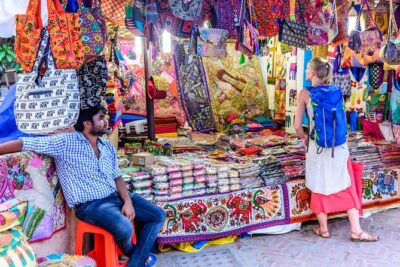 ★ 5.0Old & New Delhi City Tour – Half or Full Day Options AvailableTickets from $384,811 traveller reviews
 ★ 5.0Same Day Taj Mahal, Agra Fort & Baby Taj Tour from Delhi by CarTickets from $624,304 traveller reviews
 ★ 5.0Taj Mahal Day Tour from Delhi by Superfast Train – TOP RATED TOURTickets from $1004,166 traveller reviews
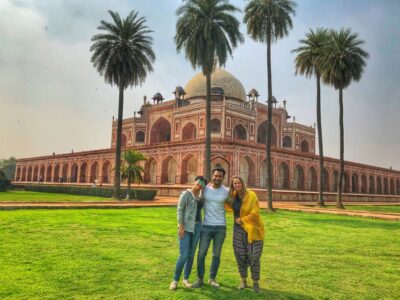 ★ 4.9Old and New Delhi Private Full or Half-Day TourTickets from $23,776 traveller reviews
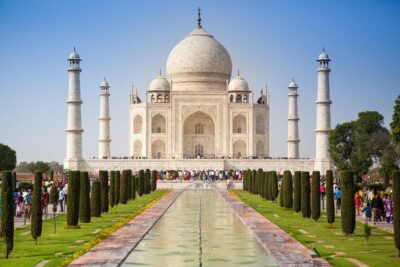 ★ 5.0Full Day Taj Mahal, Agra Fort & Baby Taj Tour from Delhi by CarTickets from $623,647 traveller reviews
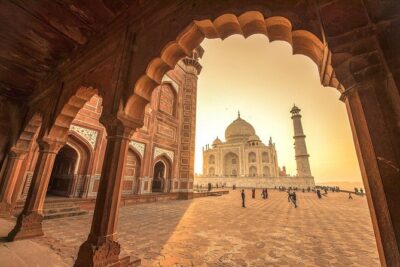 ★ 4.9From Delhi: Taj Mahal & Agra Private Day Trip with TransfersTickets from $43,181 traveller reviews
 ★ 5.0Taj Mahal Tour from Delhi by Express Train (Viator Award Winner)Tickets from $752,849 traveller reviews
 ★ 5.0All Inclusive Private Taj Mahal Luxury Tour from Delhi by CarTickets from $622,564 traveller reviews
More useful Delhi routes