

Review · DELHI CITY TOURS
Private Golden Triangle 3-Day Delhi Agra Jaipur Tour
Golden Triangle, handled with kid gloves and AC. This private 3-day run links Delhi, Agra, and Jaipur with a personal chauffeur, English-speaking driver support, and a tight route that hits the big sights without you juggling tickets and transit.
I love how the experience leans on your driver, especially Sangam, who’s described as friendly, chatty, and careful with your needs and timing. I also like the mix of famous UNESCO landmarks and easy free stops, from Qutub Minar to Lotus Temple to Jal Mahal.
One drawback to consider: it is an efficient schedule, and several headline monuments have admission fees marked as not included, so you’ll want to confirm what your package covers before you go.
Key highlights worth planning around
- Private AC car with driver and door-to-door pickup in Delhi, Noida, and Gurugram
- Sangam’s English-friendly approach that helps you understand what you are seeing while you are moving
- A morning Taj Mahal slot built around a sunrise view and guided time inside
- UNESCO time in multiple cities (Qutub Minar, Humayun’s Tomb, Agra Fort, Jantar Mantar) plus major free sights
- A realistic mix of walking and driving so you get variety without the all-day grind
Why this Golden Triangle route feels simpler than doing it alone
The Golden Triangle works best when you have a plan that reduces decision fatigue. Here, you are not trying to figure out where to start, which sights are worth the effort, or how to connect them across cities with Indian traffic in the middle of the day.
A private AC vehicle matters more than people expect. Delhi, Agra, and Jaipur all have traffic patterns that can turn a “quick hop” into a long delay. With a chauffeur handling the driving, tolls, parking, and fuel, you stay focused on the places you came to see.
You also get a “tour-day rhythm.” The schedule is organized by neighborhoods and monument clusters, so the day does not feel random. That is a big deal for first-timers, especially when you are crossing multiple cities in only three days.
You can also read our reviews of more private tours in New Delhi



Day 1 in Delhi: Qutub Minar, Mughal tombs, and Old Delhi markets
Day 1 is all about getting your bearings fast, with a classic stack of Delhi icons plus a proper Old Delhi flavor.
Qutub Minar first, because it sets the tone
You start at Qutub Minar, a UNESCO World Heritage site built in 1193 by Qutub-ud-din Aibak. Spending time here early helps because it frames the rest of your Delhi day as a long story of dynasties, architecture, and changing styles. Plan for real walking around the grounds, but your allocated time is about right for a first pass.
Admission for Qutub Minar is marked as not included, so budget for that separately unless your option includes monument entries.
Lotus Temple for calm, free, and modern architecture
Next is the Lotus Temple, constructed in 1986, and it is free. It has that signature flower-like shape, and the visit works well as a break after the older monumental scale of Qutub Minar.
This is also one of the stops where you can slow down. Even if you only have 30 minutes, it’s a nice reset for photos and people-watching without the same intensity as the big forts.
India Gate, Parliament House, and Rashtrapati Bhavan: quick views with big symbolism
After that, you glide through central Delhi highlights:
- India Gate, a war memorial near Rajpath, with free entry
- Parliament House (Sansad Bhavan), known for its circular design inspired by the Ashoka Chakra
- Rashtrapati Bhavan, the President’s residence and its surrounding presidential gardens
These are short stops on purpose. They help you see how modern India presents itself alongside the older Mughal and medieval layers you will focus on later.
More New Delhi tours and experiences for the shortlist




Agrasen Ki Baoli and Humayun’s Tomb: the Mughal-era emotional center
Agrasen Ki Baoli is a protected stepwell monument and is free. Stepwells are one of those Delhi features that rewards curiosity. Here, it is about the structure and the history of using water infrastructure in the city.
Then you go to Humayun’s Tomb, another UNESCO site, commissioned in 1558 by Empress Bega Begum. Admission for Humayun’s Tomb is marked not included, so again, tickets may be on you unless your package covers them.
This area tends to feel more spacious than Old Delhi. If you want one stop that feels contemplative, it’s often Humayun’s Tomb and the gardens around it.
Chandni Chowk and Jama Masjid: Old Delhi shopping and scale
Your Old Delhi time includes Chandni Chowk, a market zone known for spices, dried fruits, silver jewelry, and colorful saris. It is a perfect place to buy small, practical souvenirs, but also a place where your time can disappear fast if you wander too long.
Then you visit Jama Masjid, one of India’s largest mosques, commissioned by Mughal Emperor Shah Jahan in 1650 and completed in 1656. The schedule gives you a block of time for it. Since this is a religious site, you might want to plan modest clothing and expect some crowd flow.
Red Fort and the drive to Agra
You finish Day 1 at Red Fort, a Mughal-era residence for emperors until 1856. Admission is marked not included. Your time here is about an hour, which is enough to appreciate the scale and plan what you would want to revisit later in life.
After a lunch stop connected to the Yamuna Express Way drive, you head to Agra and check into your hotel for the night. Travel time is listed at about three hours, so keep your energy for an early start on Day 2.
Day 2 in Agra: sunrise Taj Mahal, fort views, and Fatehpur Sikri
Day 2 is where the Golden Triangle stops being “lots of monuments” and turns into a set of headline moments.
Taj Mahal at sunrise: the headline you came for
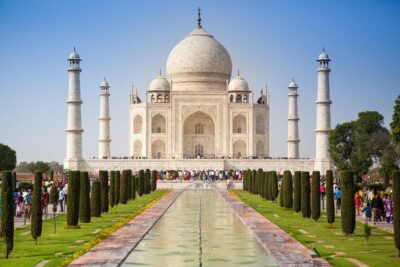
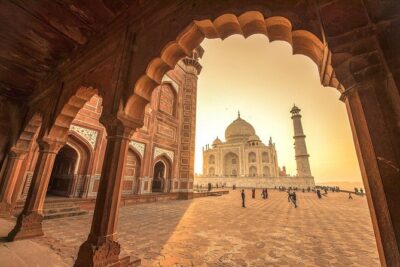
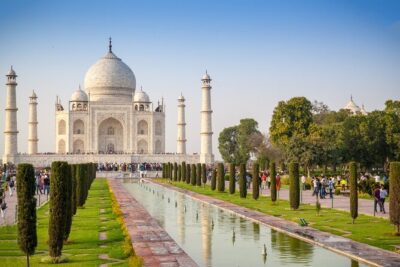
You start early with a sunrise view of the Taj Mahal, plus a guided visit inside. It is UNESCO-listed and also recognized as one of the New 7 Wonders of the World.
Admission for the Taj Mahal is marked not included, so make sure your budget accounts for that. Also, sunrise visits mean your hotel morning routine needs to run smoothly. If you are sensitive to early alarms, plan your sleep like it matters, because it does.
Agra Fort: the bigger, tougher complement to Taj Mahal
Next is Agra Fort, another UNESCO site and one of the most iconic forts in India. Admission is marked not included, and you get about an hour.
This is a smart pairing with the Taj. Taj Mahal gives you romance and geometry. Agra Fort gives you power and practical empire architecture. Even if you only skim the highlights, you’ll leave with a clearer sense of how the Mughal world worked.
Itmad-ud-Daula, also called Baby Taj
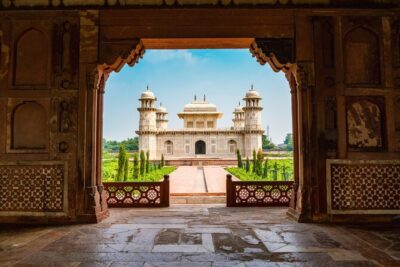
Then you visit Itmad-ud-Daula, often nicknamed the Baby Taj. This one is free in the schedule, and it’s a great contrast to the big-ticket monuments. It has that refined mausoleum feel, and it helps you notice details you might miss if everything is the largest version of itself.
Fatehpur Sikri: a short visit to Akbar’s fortified city
After Agra, you continue to Fatehpur Sikri, the fortified city founded by Emperor Akbar in 1569. It is free in this plan and gives you about an hour.
Fatehpur Sikri can feel like stepping into a city that is partly museum and partly living history. The short time means you will not see everything. But you will get the main feel, and that is often what a three-day tour needs.
Chand Baori stepwell: engineering that still shocks
Then you go to Chand Baori, a stepwell built in the 8th and 9th centuries with over 3,500 steps. Admission is marked not included, and your stop is around 30 minutes.
This stop is popular for a reason. The design is simple to understand, but it’s visually intense. Even if you only walk in a limited area, it is one of the more distinctive “architecture nerd” experiences on the route.
Arrive Jaipur, sleep, and reset
After sightseeing, you transfer to Jaipur and check into your hotel for an overnight stay. Day 2 is long and includes both historic city stops and travel. Take advantage of the hotel time. This tour works because your sleep sets you up for the full Day 3 in Jaipur.
Day 3 in Jaipur: Hawa Mahal, Jantar Mantar, City Palace, plus Amer
Jaipur day is built around variety: palace facades, astronomical instruments, ceremonial buildings, lakeside views, and an outing to Amer.
Hawa Mahal: the Palace of Breeze
You start at Hawa Mahal, built in 1799 by Sawai Pratap Singh. It’s a striking five-storey sandstone structure with that famous front facade full of small windows.
Admission is marked not included. Since your time is around 45 minutes, go in with a plan: take photos from the outside first, then focus on how the design works once you are in.
Jantar Mantar: UNESCO time with scientific tools
Next is Jantar Mantar, a UNESCO World Heritage site constructed in 1734. The complex includes nineteen astronomical instruments commissioned by Rajput king Sawai Jai Singh II.
Admission is marked not included, and you get about 45 minutes. This is one of the best “wow, that’s clever” stops on the Golden Triangle. You see how rulers used instruments to measure the sky, and you can look for how each tool serves a different purpose.
City Palace: the center of power
The City Palace takes about two hours, and it is marked not included for admission. Built in 1721, it served as the administrative and ceremonial hub for the Maharaja of Jaipur and still houses important residences and collections.
Even with a limited time window, City Palace helps you connect Jaipur’s look to the people who shaped the city.
Royal Gaitor Tumbas and Jal Mahal: a day with mood shifts
Then you visit Royal Gaitor Tumbas, associated with the cremation of Maharajas of Rajasthan. The site is about 15 km from Jaipur and located at the base of Nahagarh Fort. Admission is marked not included, and the stop is short.
After that, you get Jal Mahal by Man Sagar Lake. It is free in the schedule, and your time is only 15 minutes.
That short lake stop is a smart palate cleanser. It gives you a change of pace after palace interiors and historic complexes.
Amer: Jaipur’s old-world edge
Finally, you go to Amer, a historic town on the outskirts of Jaipur. It is marked free in the plan and gives you about an hour.
Since the schedule doesn’t specify every component, treat Amer as a flexible “take in the old Jaipur vibe” portion. Wear comfortable shoes and keep your camera ready. This is where the city starts to feel less like sightseeing blocks and more like a place with its own rhythm.
Head back toward Delhi or your Jaipur airport drop
After Jaipur, you transfer back to Delhi, about five hours, or get dropped at Jaipur airport. That is a long ride after a full day of stops, so if you can, plan a quiet evening at your destination.
Price and what you really get for about $134.20 per person
At around $134.20 per person for three days, the value depends on which option you choose and how many admission tickets you must pay separately.
Here’s what is clearly included:
- Pickup available from airport, railway station, hotel, and other locations in Delhi, Noida, and Gurugram
- A private AC vehicle with an English-speaking driver
- Fuel, tolls, parking, and all taxes covered for the drive
- Tour guides and monument entry fees if you select the option that includes them
- Breakfast for 2 days in the included package
- 2 nights of accommodation if you book the version that includes hotels
Car choice changes with group size. For 1 to 3 passengers, it is a Maruti Dzire or Toyota Etios Sedan. For 4 to 5, it shifts to a Maruti XL6 or Toyota Crysta SUV. For 6 to 10, you use a minivan or tempo traveler. Translation: you usually get a vehicle that makes sense for your party size, which helps comfort over long road hours.
The biggest value is time and coordination. Instead of booking separate guides, syncing your own transport between Delhi and Agra and then to Jaipur, you get a single plan with a driver who keeps everything moving.
What to budget for tickets, meals, and the “pay as you go” reality
Admission rules are mixed on this tour. Some stops are marked free, and several major ones are marked not included.
Places marked admission not included in the schedule:
- Qutub Minar
- Humayun’s Tomb
- Red Fort
- Taj Mahal
- Agra Fort
- Chand Baori
- Hawa Mahal
- Jantar Mantar
- City Palace
- Royal Gaitor Tumbas
Places marked free in the schedule:
- Lotus Temple
- India Gate
- Parliament House
- Rashtrapati Bhavan
- Agrasen Ki Baoli
- Chandni Chowk
- Jama Masjid
- Itmad-ud-Daula
- Fatehpur Sikri
- Jal Mahal
- Amer
Because the included section says monument entry fees can be added if you choose that option, your real out-of-pocket ticket amount depends on what you book. My practical advice: before you lock it in, confirm which of the not-included monuments you will actually have paid entry for.
Meals are also mostly on you. Breakfast is included for 2 days, and the schedule notes lunch during the expressway drive in transit. Since meals are listed as not included, plan on budgeting for lunch and dinner each day.
Shopping is free time plus Old Delhi markets, so you will be tempted. Keep a short, simple plan like what you want to buy, a rough budget, and a place you want to stop. Otherwise, Chandni Chowk can turn into a full adventure.
Comfort tips for three cities in three days
This is a fast-moving classic route. That’s not a criticism, it’s just how the Golden Triangle works when you compress it.
- Bring comfortable walking shoes. You do not just “look.” You walk through monument grounds, markets, and palace areas.
- Protect yourself from the sun. You have outdoor time across Delhi, Agra, and Jaipur, including early morning.
- Expect some crowding at the most famous spots like Taj Mahal and major forts. Build a patient mindset, because your schedule is built on seeing key icons rather than slow wandering.
- Keep small bills and a card ready for lunches and optional purchases. Several stops are free, but you will likely pay for paid entry and food.
If you can, pack light but smart. With a private car, you do not constantly change hotels, but you still need a day bag for water, sunscreen, and tickets.
Who this private 3-day Golden Triangle tour is best for
This tour fits you best if:
- You are short on time and want Delhi, Agra, and Jaipur in one organized flow
- You prefer a private chauffeur instead of figuring out public transport and meeting points
- You want a mix of major landmarks and free stops, not just museums and monuments
- You appreciate guidance that helps you understand what you are looking at, especially with an English-speaking driver like Sangam
It may not be your best match if you want long stays, deep museum hours, or lots of free time each day. The schedule is designed for efficient coverage, so you trade freedom for momentum.
This is also a solid choice for couples and small groups. It can work for larger parties too because vehicle options scale up.
Should you book this Golden Triangle 3-day private tour?
If your goal is a smooth, first-time Golden Triangle circuit, this is a strong option. The private AC vehicle, pickup coverage in Delhi, and the structured monument blocks save you a lot of mental work, especially on day-to-day logistics.
I would book it if you:
- Want a plan that takes you from UNESCO-heavy Delhi to sunrise Taj Mahal to top Jaipur landmarks
- Value having an English-speaking driver who can keep you on schedule and oriented
- Are okay paying admission fees for major sights unless your package includes them
I would pause and ask questions if:
- You strongly prefer a slower pace or lots of unscheduled time
- You want every major monument ticket included, since several big ones are marked not included in the schedule
FAQ
FAQ
What cities does the 3-day tour cover?
It covers New Delhi, Agra, and Jaipur.
Is pickup included?
Yes. Pickup is available from the airport, railway station, hotel, or any location in Delhi, Noida, and Gurugram.
Do I get a private vehicle?
Yes. It is a private tour/activity with your group only, using a private AC vehicle and an English-speaking driver.
Are monument entry tickets included?
Some are marked as not included, while others are free. The tour also mentions that tour guides and monument entry fees may be included if you select that option.
Is Taj Mahal included?
Yes. You will visit the Taj Mahal at sunrise with a guided tour inside (admission ticket is marked not included).
How many nights of hotel stay are included?
It includes 2 nights of accommodation if you book the option that includes hotels.
Are meals included?
Breakfast is included for 2 days. Other meals are not included.
What is the approximate drive time between Jaipur and Delhi?
The transfer back to Delhi is listed as approximately five hours, or you can be dropped at Jaipur airport.
What is the cancellation policy?
Free cancellation is available. You can cancel up to 24 hours in advance for a full refund. If you cancel less than 24 hours before the start time, the amount paid is not refunded.
More Private Tours in New Delhi



More Tours in New Delhi





More Tour Reviews in New Delhi
Not for you? Here's more nearby things to do in New Delhi we have reviewed








More Delhi City Tours to consider.
 ★ 5.0Old & New Delhi City Tour – Half or Full Day Options AvailableTickets from $384,811 traveller reviews
 ★ 5.0Same Day Taj Mahal, Agra Fort & Baby Taj Tour from Delhi by CarTickets from $624,304 traveller reviews
 ★ 5.0Taj Mahal Day Tour from Delhi by Superfast Train – TOP RATED TOURTickets from $1004,166 traveller reviews
 ★ 4.9Old and New Delhi Private Full or Half-Day TourTickets from $23,776 traveller reviews
 ★ 5.0Full Day Taj Mahal, Agra Fort & Baby Taj Tour from Delhi by CarTickets from $623,647 traveller reviews
 ★ 4.9From Delhi: Taj Mahal & Agra Private Day Trip with TransfersTickets from $43,181 traveller reviews
 ★ 5.0Taj Mahal Tour from Delhi by Express Train (Viator Award Winner)Tickets from $752,849 traveller reviews
 ★ 5.0All Inclusive Private Taj Mahal Luxury Tour from Delhi by CarTickets from $622,564 traveller reviews
More useful Delhi routes